If you've noticed wasps disappearing under a fascia board, or a steady stream wiggling their way into a gap around the eaves, there's a nest somewhere in your roof structure. What's less obvious is how long it's been there, how large it has (or can) become, and what havoc it’s wrought on your roof or attic since it was built.
This blog will cover how a loft or wall cavity nest develops through the season, the specific damage a large active colony causes, and how and when to treat it.
A queen wasp emerges from hibernation in April, and starts off building her nest alone, in a suitable spot. A roof or loft ticks all the boxes: its’ warm, tucked away, and has plenty of timber to chew for nest material.
Nests are built in layers. At first, it will be little bigger than a golf ball, but as the queen builds her colony up, the workers will contribute, expanding the nest. They forage for food, chew up the structure of homes to reuse as nest material, and feed the next generation of larvae. By August, a nest will house anywhere from 5,000 to 10,000 workers and will have expanded up to the size of a football, or even larger. This is around the time they switch to prioritising sugar and food, which is why they get more aggressive and noisier at this time.
The reason most people don't spot a loft or wall cavity nest earlier is that the signs are easy to miss when the population is smaller and less aggressive. It's usually only when the flight line into an entry point becomes obvious, or wasps start appearing indoors near ceiling lights and loft hatches, that people start to look more carefully. By then, the active colony has been in there for months already.
The damage a nest can do will depend on its’ size, activity, and time of year, but thankfully, wasps aren’t inherently destructive. If the nest is small, or in the early stages of development, you have nothing to worry about yet, but you should get it removed before that changes. If its’ already mid to late summer, its’ a different matter entirely.
Workers build the nest by scraping surface fibres from rafters, joists, fascia boards, and any untreated or weathered timber they can reach, mixing it with saliva to produce the papery nest material. The damage to individual timbers starts off surface-level, not structural, but in a confined loft with thousands of workers operating from April through to October, it accumulates. If a new colony establishes in a similar spot the following year (which is quite likely if none of the conditions that make it appealing to the queen have changed), the surface degradation will compound season by season.
As the nest expands, it physically compresses and displaces whatever is around it. In a loft where mineral wool runs between the joists, a nest that grows to football size or larger doesn't leave that insulation intact. Compressed insulation loses thermal performance, while displaced insulation leaves gaps.
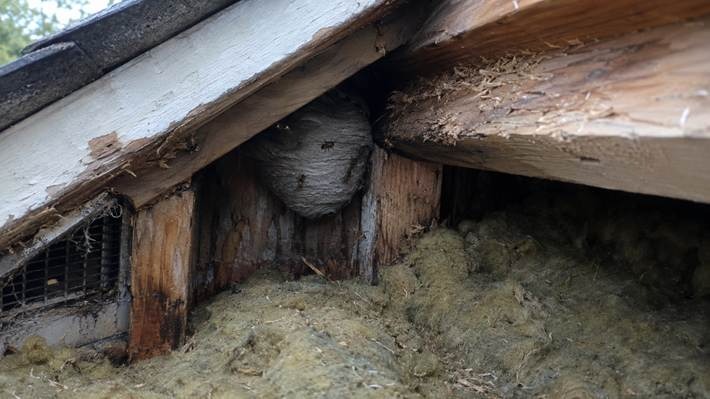
Loft spaces rely on vents and air bricks to let moisture-laden air out. When that airflow is restricted, moisture builds up inside the roof space, condensing on cold timbers, on the underside of the roof deck, and in the insulation. Damp timber over time creates the conditions for rot and fungal decay. A large nest built against or across a vent can block that airflow entirely, and queens find vents attractive in spring because they're warm and sheltered, so it's not uncommon. The damp that results is too often misinterpreted as a roof leak, with the wrong professionals coming out to investigate a water ingress only to find a wasps’ nest instead.
Wasps get in through an existing gap, like a crack in the mortar, a loose soffit, a displaced tile. Over a season of constant traffic, that gap widens. When the colony dies off in autumn, it stays widened, and it's now a slightly more accessible route in for moisture, secondary pests, and next year's queens looking for a nest site.
The worker wasps die off in late autumn, and then the nest is abandoned. But it doesn’t go anywhere. A large abandoned nest in loft insulation gradually absorbs moisture as it deteriorates, adding to any damp it caused or exacerbated in the first place. Old nests also attract secondary pests, like wax moths, rats, and certain beetle species. They use them for harbourage and nesting material of their own.
If nothing about your roof changes (same warmth, the same low disturbance, the same entry point), you may run into more trouble next spring. Wasps don't reuse old nests, but they do return to locations that suited them before, and new queens scout for exactly those conditions each spring. An unsealed entry point is effectively a standing invitation.
We've been handling wasp nests in lofts and roofs across Bristol, Bath, and the surrounding area for over 30 years. If you've got an active colony in your roof and want it dealt with properly, give our friendly team a call at 0117 444 9821 or book a visit online. We'll always give you a fixed price before we start, with no surprises on the day.
For a loft or roof cavity nest, treatment is applied as an insecticidal dust directly into the entry point. Returning workers carry it through as they pass in and out, and it works its way into the nest. The colony is rendered inactive within 24 to 48 hours.
Once the colony is confirmed inactive, we'd normally recommend removing the nest: it reduces the secondary pest risk, removes some of the attraction for queens the following spring, and clears any blocked vents. Where a nest is completely inaccessible, leaving it once the wasps are gone causes no ongoing problem, but we will always let you know what you need to for your case.
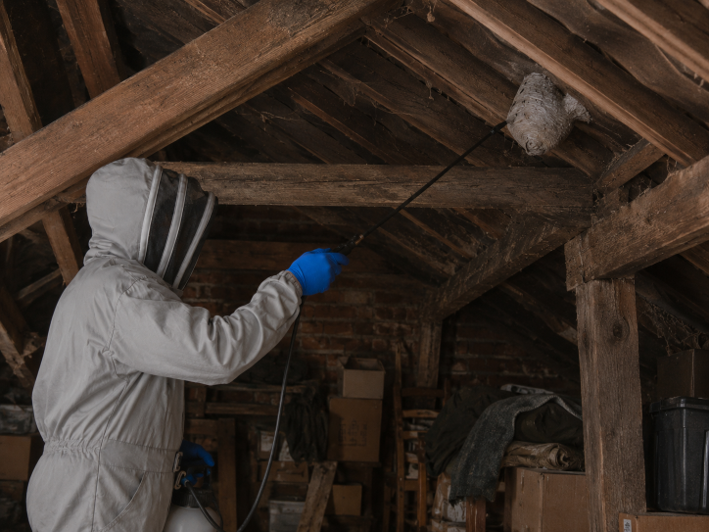
For some people, their first instinct when they suspect they have a wasp problem is to go up and investigate. We can see why, but if ever that was a bad idea, it would be here in late summer, when the colony is at peak population and workers are at their most defensive.
Earlier in the season, when the nest is small and workers are occupied feeding larvae, they're largely focused on that (but don’t push your luck!). By August the larvae are gone, the workers have no job, and the colony is aggressively protective of the nest. A loft gives you very little room to move and no quick way out if it kicks off. Climbing back down a ladder with an agitated colony above you is not a situation you want.
Blocking the entry point yourself is just as likely to cause problems. It makes sense on paper: stop more wasps getting in. But sealing the gap while the nest is active traps thousands of wasps inside the roof structure, and they will find another way out. That could be through ceiling light fittings, around the loft hatch, or through gaps in skirting boards, straight into your living space.
Consumer aerosol sprays don't get near it, either. Spraying into a void agitates the colony without reaching the nest. The wasps scatter deeper into the roof, the nest is untouched, and now they're disturbed and defensive.
The colony will die off naturally, but the nest doesn't leave with it, the entry point doesn't seal itself, and the conditions that attracted this colony will still be there next spring. Dealing with an active nest now resolves the problem once and for all. Leaving it might mean inheriting damp insulation, a blocked vent, a wider entry point, or another colony moving in next April.
If you've spotted the signs in your home, get in touch with our team. We've been treating wasp nests across Bristol and Bath since 1995, we'll come out promptly, sometimes on the same day, and we’ll always give you a fixed and fair quote before the work is done. For more pest advice through the rest of the summer, follow us on Facebook and have a read through our other blogs.
Reach out for expert pest advice or to schedule a service.
Find clear answers to common pest control queries. Learn about our services, safety standards, and what to expect from Action Force Pest Prevention.
We handle a wide range of pests including rodents, insects, wasps, and more. Our BPCA-certified team uses safe, effective methods tailored to your needs.
Yes. All products and procedures are approved for use in homes and businesses, prioritising safety for people and pets at every step.
We offer flexible appointments Monday to Saturday, 8am–8pm. Most enquiries receive a same-day or next-day response from our local team.
Yes. We stand by our work with clear guarantees and offer follow-up visits if needed to ensure your pest problem is fully resolved.